How to Use Our Chord Formula
If you have purchased any of our instructional books and materials, chances are you have come across the Chord Formula diagram.
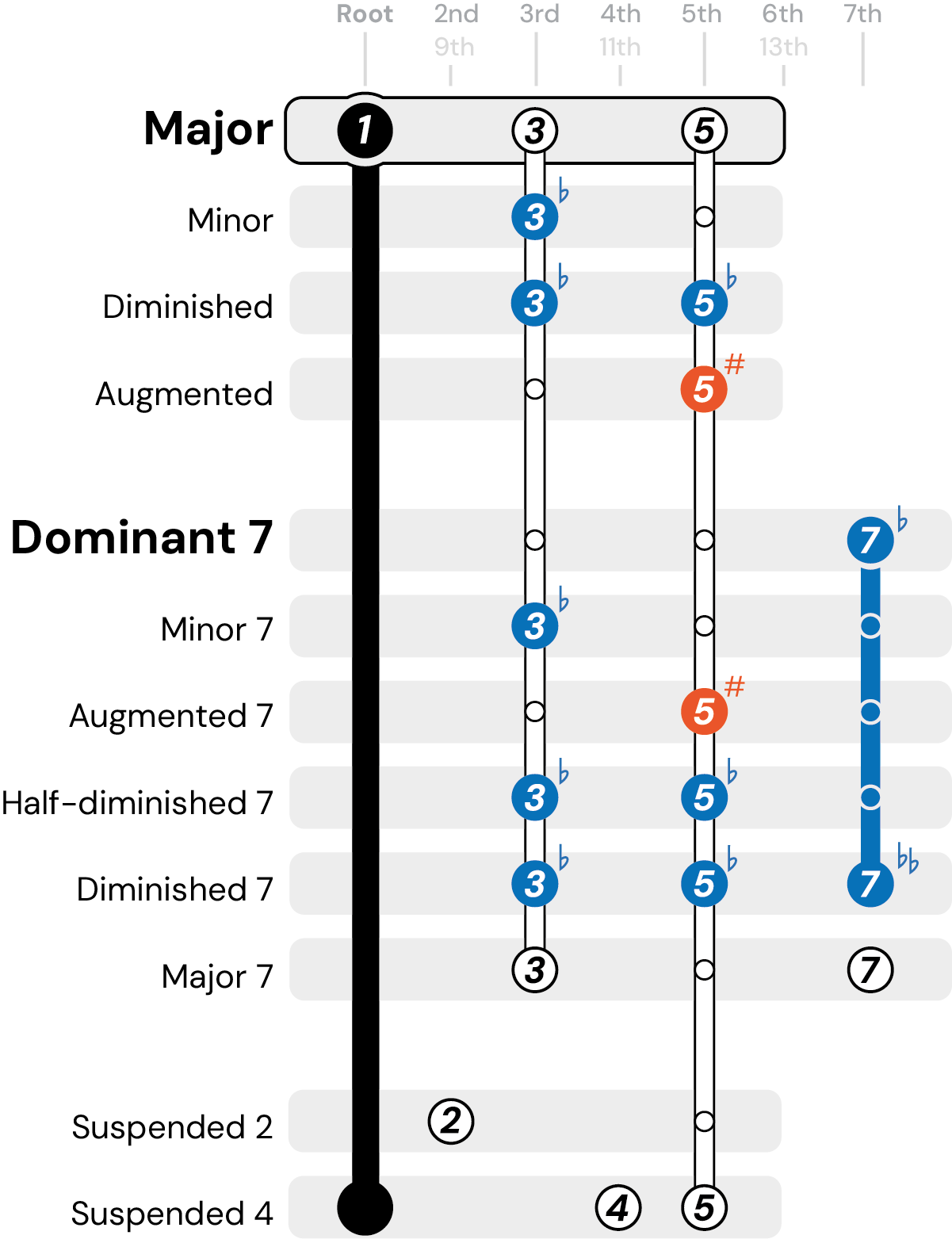
This diagram helps in learning how chords are formed, which notes are found in a certain chord and what type of chords can be built. But the question is: how do we actually use it?
In this blog, we will show you how you can use the diagram in figuring out the chords you need to write songs and make music!
Anatomy of the Chord Formula
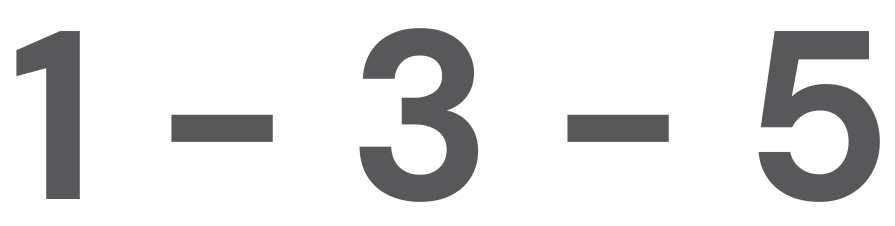
Looking at the diagram for the first time might be a little bit intimidating, but trust us, this is all simple as 1-3-5!
The chord formula is the key to understanding chords. The Major Chord, shown at the top, is the fundamental chord that is the basis of all other chords.
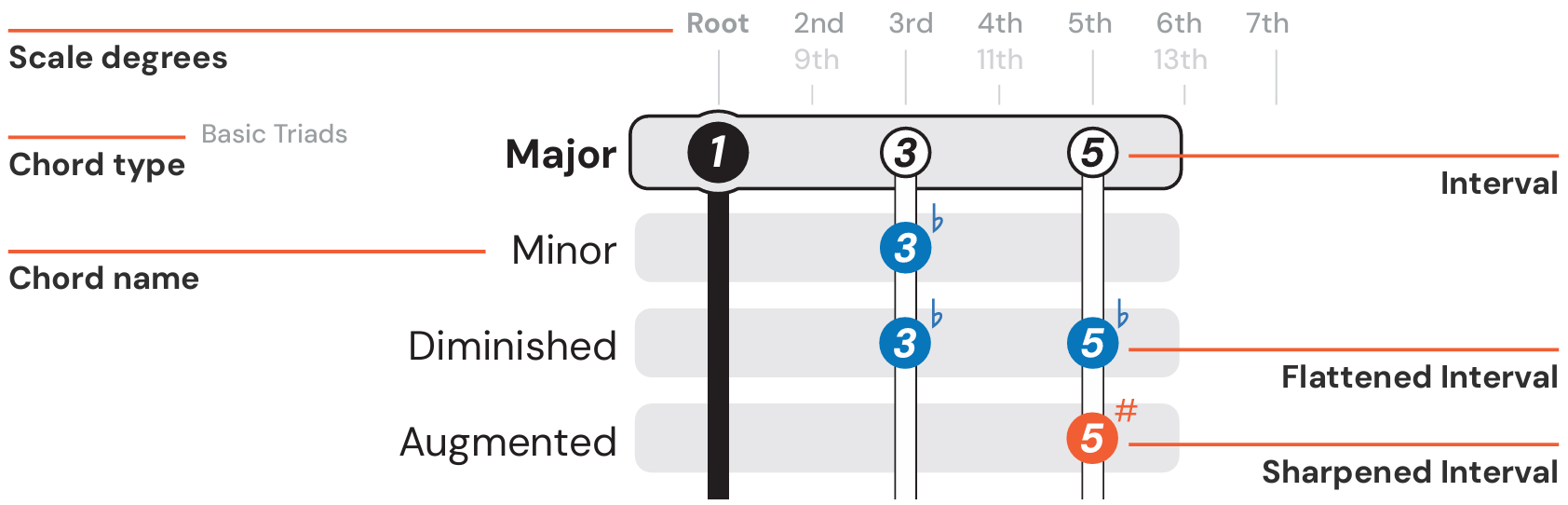
The first line represents the Intervals of the major chord: 1—3—5. All other chords are derived from this chord. Each row below is a different type of chord and highlights the change in relation to the major chord.
All chords are derived from the major scale.
The starting point for all chords is the Major chord, built using the 1—3—5 from the major scale. The diagram below shows how we represent this. Any other chord is a deviation from this simple chord.
The chord formula simply highlights where the type of chord differs from the Major Chord. The minor chord replaces the major 3rd with a minor 3rd. This change is highlighted in blue on the chord formula. All flattened intervals are shown as blue on our diagrams, and all sharpened intervals are shown as orange.
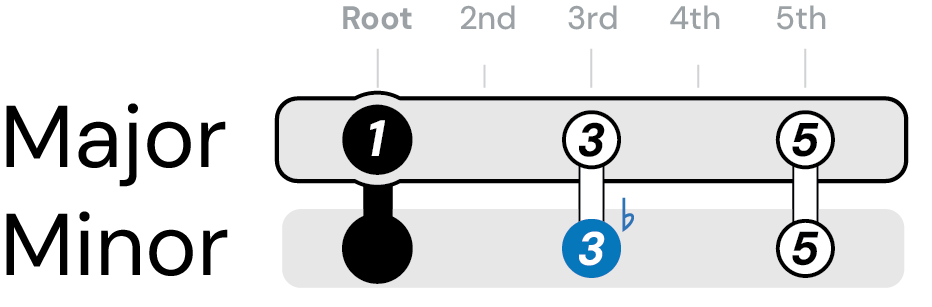
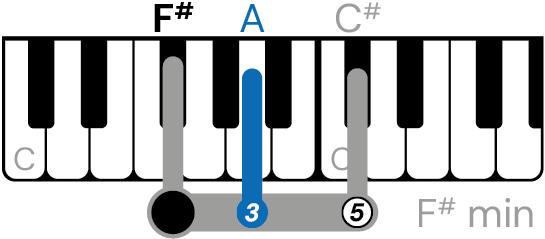
This does not necessarily mean it is a sharp or flat note, it just means whatever interval in the major chord has been moved down (flattened) or up (sharpened) one key.
To show what we mean by this, look at the F# minor chord shown below, the flattened third (the blue finger with the 3) is an A natural note.
Triads
Triads are chords that consist of 3 notes, there are multiple types of triads that use different intervals to the Major triad. Let’s learn each triad.
The Major Chord
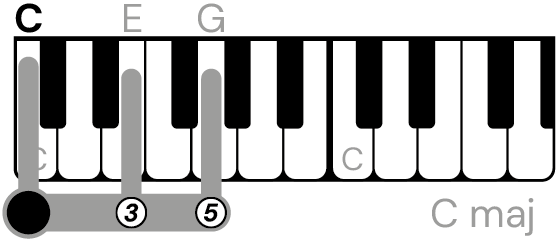
The Major chord is the bread and butter of music. It consists of three intervals: 1—3—5. All other chords can be derived from these three notes.
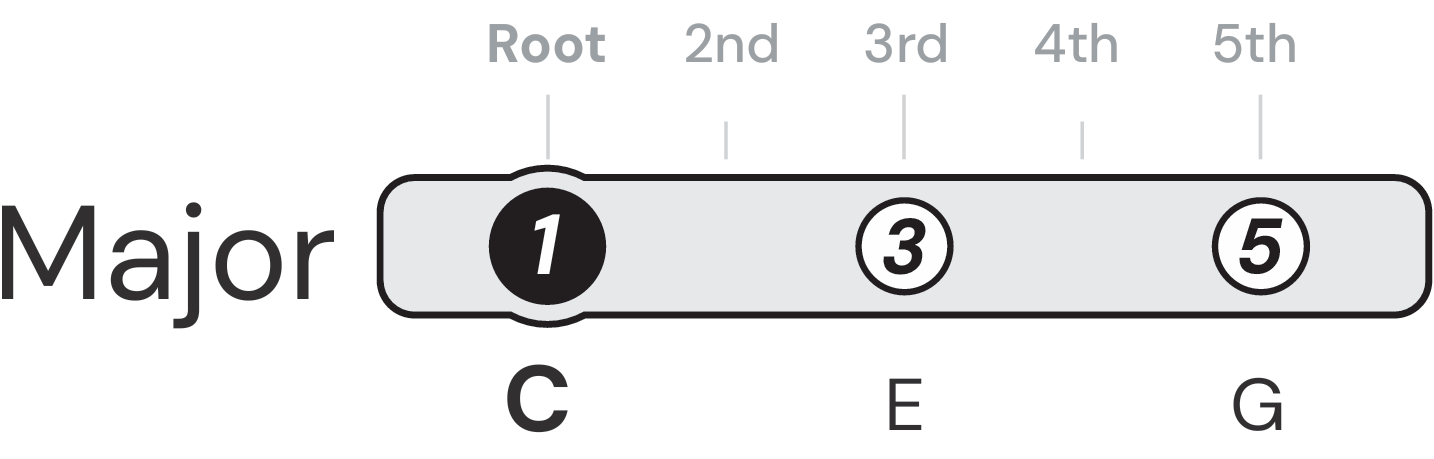
Name: C major
Symbol: C, C Maj, CM, Cmaj, C∆ (This is one of the most common chords and often will be represented as a single letter and not have a symbol, the assumption being that it is in major.)
Trivia: Major chords are used in nearly every song! ‘Hotel California’ by The Eagles uses five different major chords in a row.
The Minor Chord
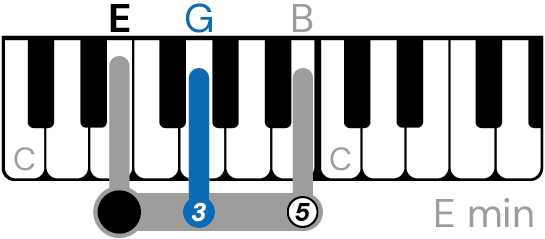
The minor chord is the sad melancholic sibling of the major chord. The only difference between major and minor is the 3rd interval, which is lowered/flattened by a semitone, or half-step. The 3rd is one of the more indispensable notes in a chord. It is easy to lose the 5th but everything becomes very ambiguous when you don’t have the third.
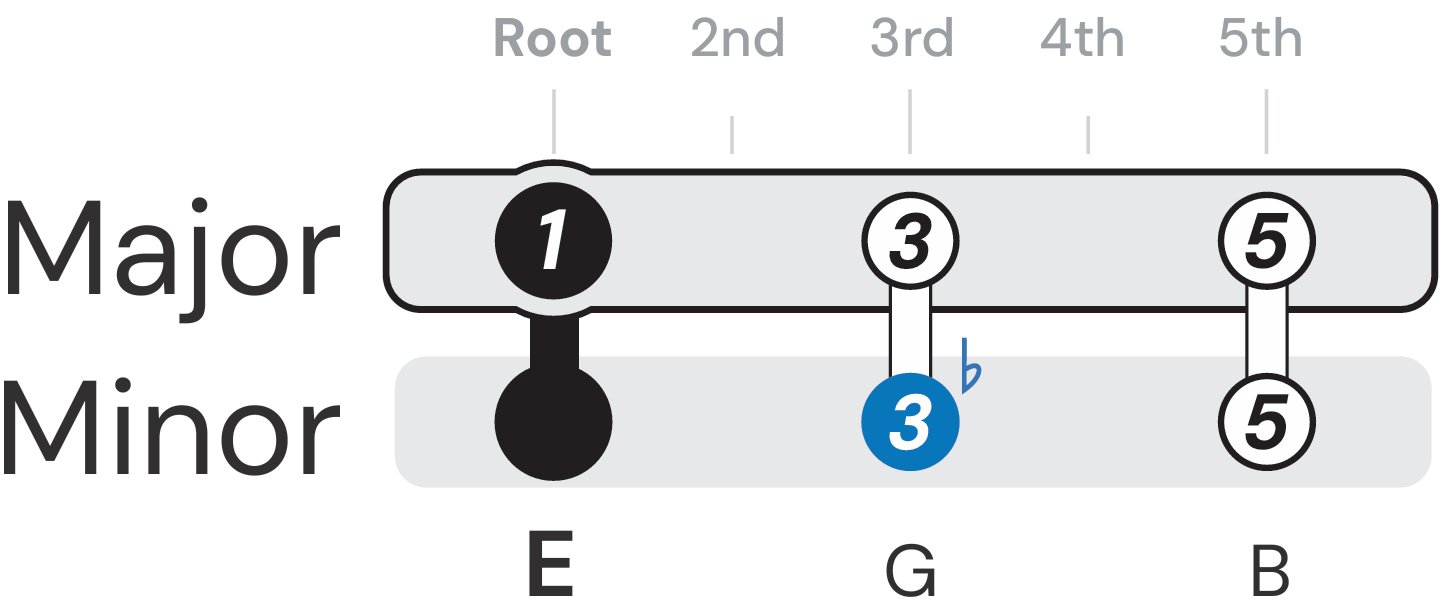
Name: E minor
Symbol: Emin, Em, E-
Trivia: There are very few songs that only use minor chords.
The Diminished Chord
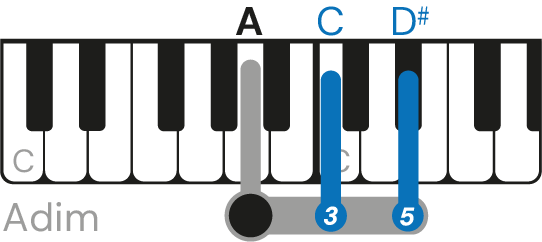
The diminished chord rarely shows up, but when it does it really makes an impact. The 3rd and 5th are both lowered by a semitone, or half-step, to form the diminished chord. They add tension and often feel dark and dissonant
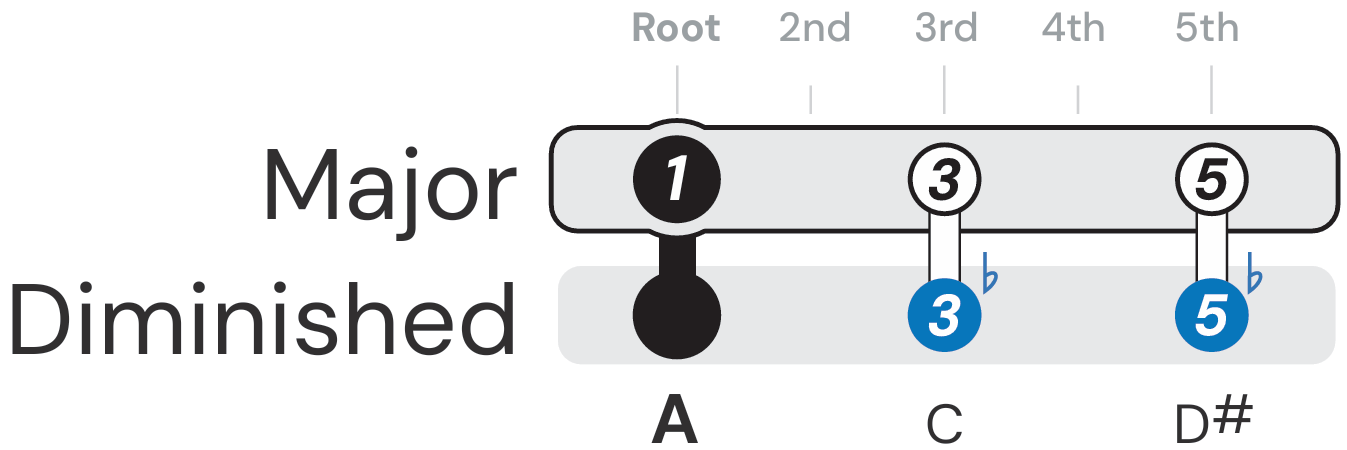
Name: A Diminished
Symbol: Adim, A°
Trivia: Diminished chords can be great transition chords as they bring a lot of tension which is then relieved when the chord resolves to the root or other major chord.
The Augmented Chord
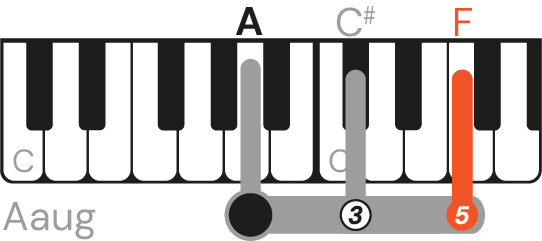
The Augmented Chord adds a lot of tension in a chord progression. To make an augmented chord, the fifth is raised by a semitone, or half-step.
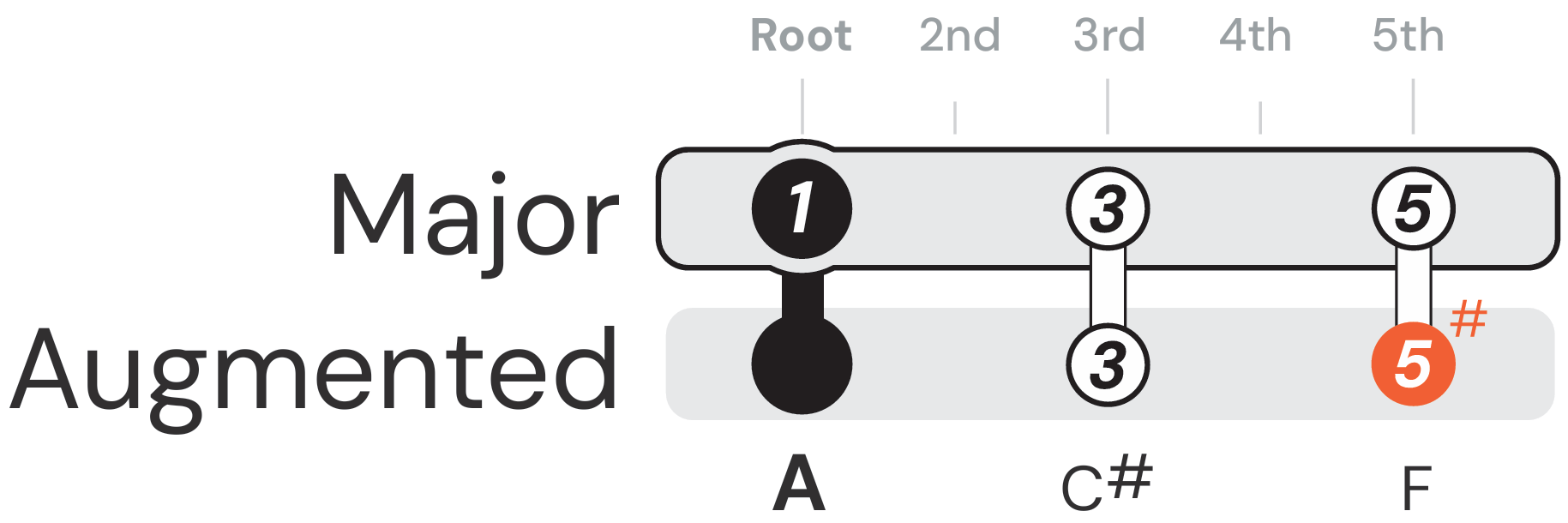
Name: A augmented
Symbol: A+, A aug, A(#5)
Trivia: Augmented triads sound nearly identical in all inversions. It is the note a semitone, or half-step, up from the 5th.
Seventh Chords
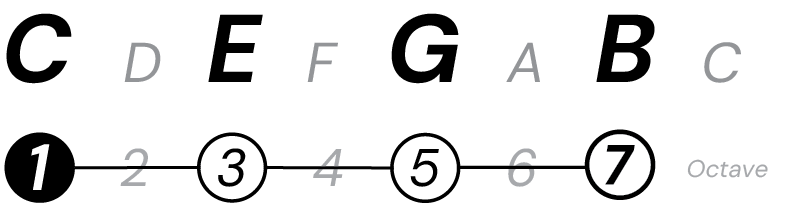
A 7th chord adds a 4th note to a triad - the 7th interval of the scale. Let’s look at a regular triad below.
Then we can add the 7th note into the triad, making it a seventh chord. This is the first of what we call “extended chords”

As the name suggests, extensions add to the existing chord but don’t change the basic flavour of the chord.
There are a bunch of seventh chords available, but let’s learn about a few important ones.
The Dominant 7th
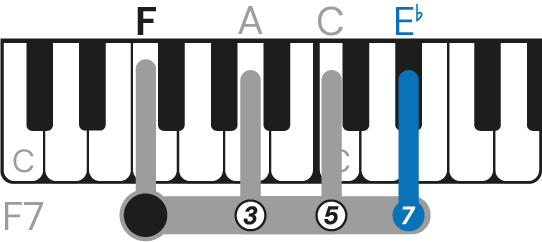
The dominant 7th is one of the first extended chords a musician learns. They are the gateway chord for extensions. The dominant 7th is the one chord that breaks the chord naming rules, because whenever you see a note followed by a 7 alone you add the flattened 7. For example: F7 adds E , the flattened 7th scale degree, to the F major triad.
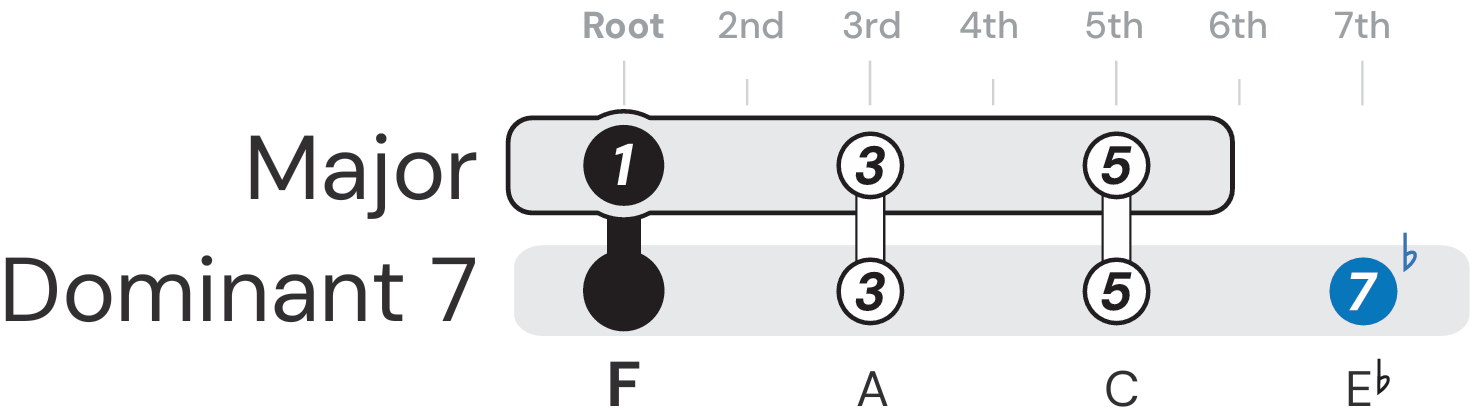
Name: F Dominant , F major minor 7
Symbol: F7
Trivia: The dominant 7th appears frequently in popular songs and often plays a crucial role in building harmonic tension by creating a strong pull towards the tonic chord.
The Major 7th
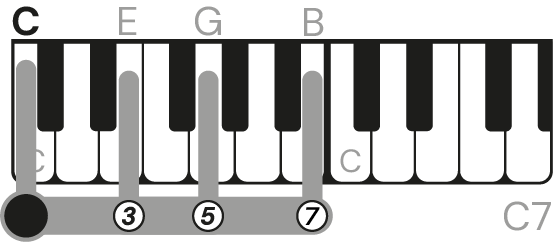
The Major 7th chord simply adds the 7th scale degree to the major chord. It is the only 7th chord that adds the Major 7th interval. All other 7th chords use the minor 7th interval.
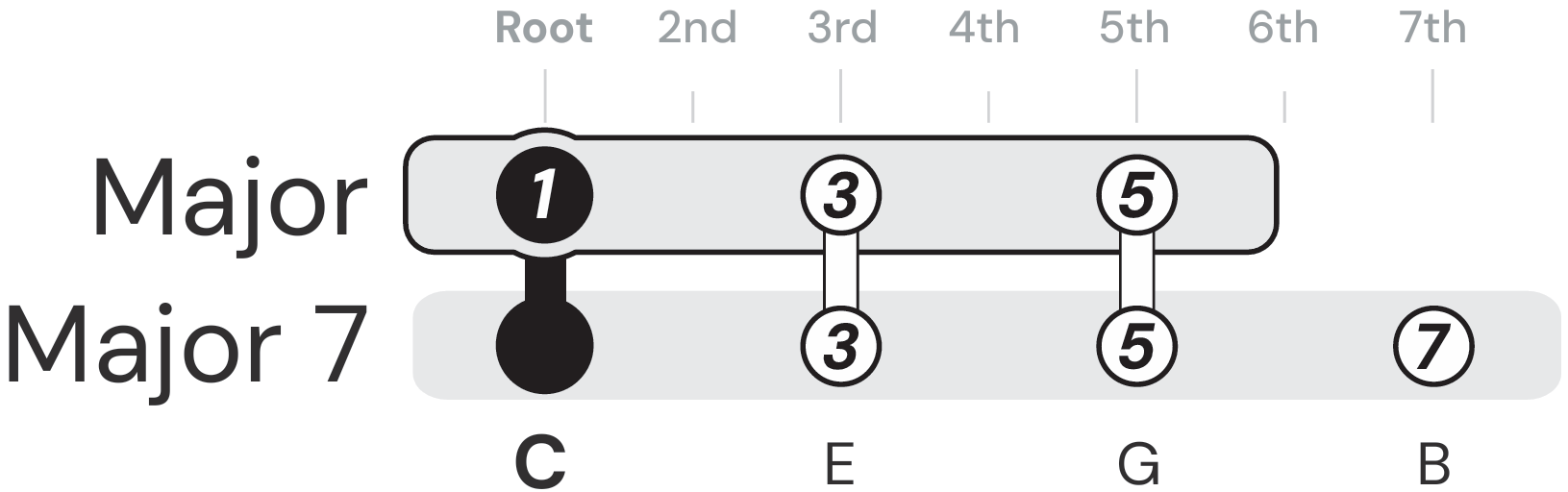
Name: C major 7
Symbol: C∆, CMaj7, CM7, C∆7
Trivia: An easy way to play CMaj7 with your right hand is to start with your thumb on the 3rd and play the root note right above the 7th with your pinky. This is called an inversion, as the root is not the lowest note.
The Minor 7th
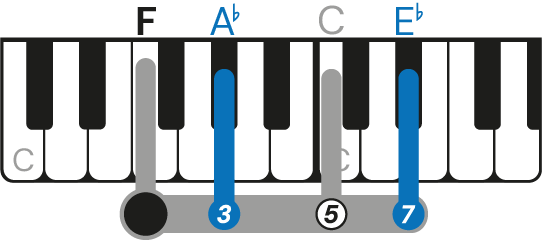
The minor 7th flattens the third interval in a dominant 7th chord. There are three naturally occurring minor seventh chords in a major key - formed from the 2, 3 and 6 minor chords.
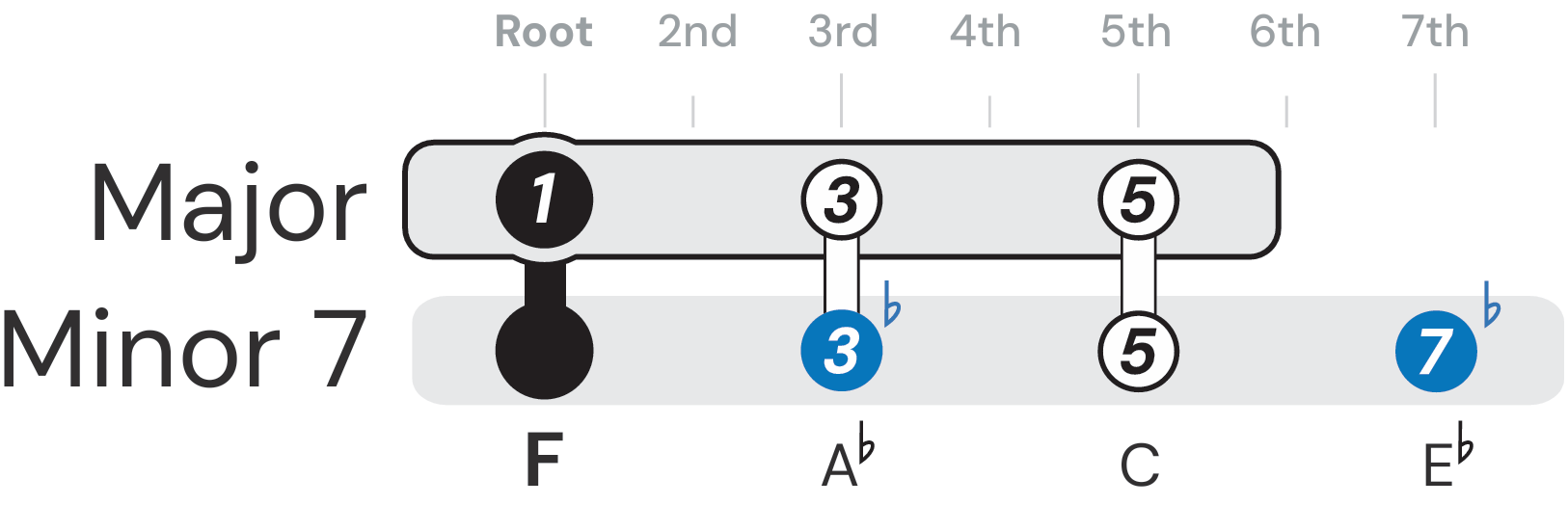
Name: F minor 7
Symbol: F-7, Fm7, Fmin7, Fmi7
Trivia: All minor extensions are built from this chord. The minor seventh chord (e.g. Am7) is often referred to as one of the defining sounds of jazz music.
If you’re interested to learn more seventh chords check out our —--- !
Suspended Chords
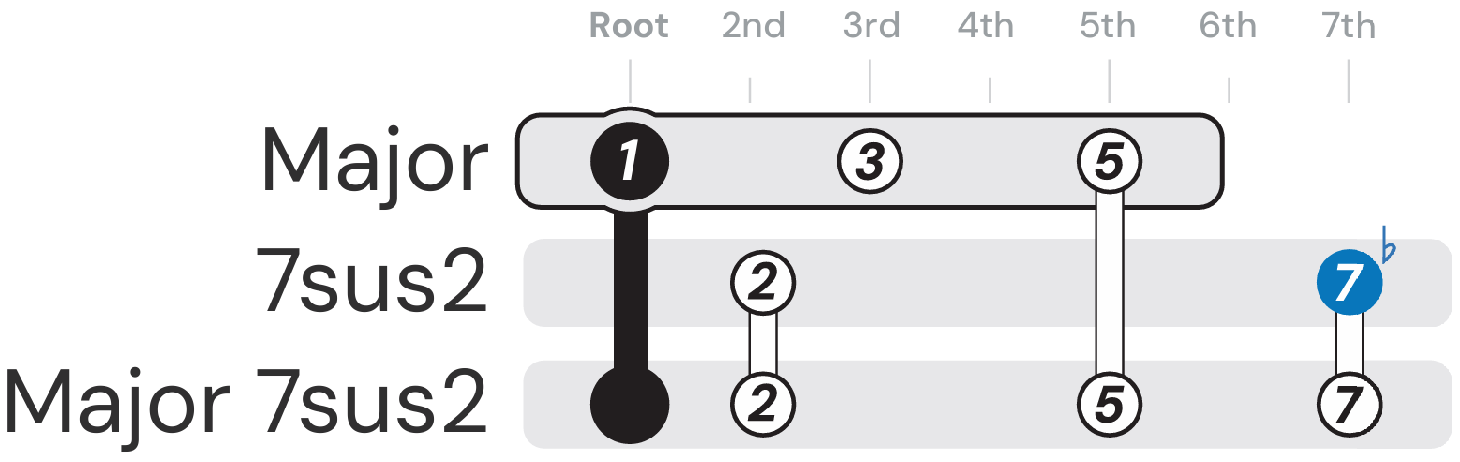
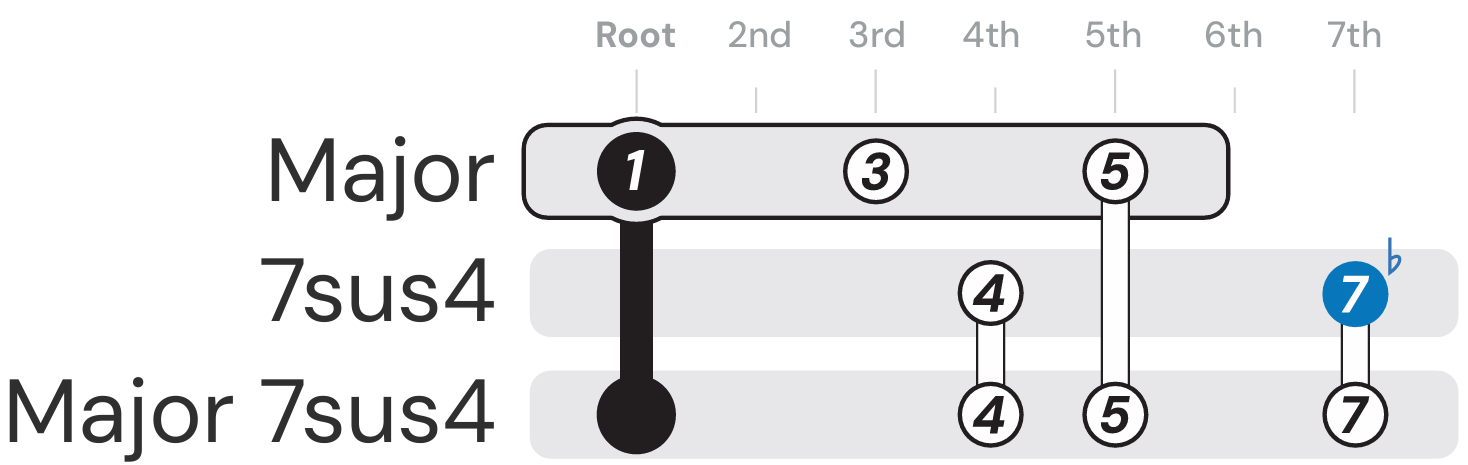
Suspended chords are a type of chord where we “suspend” the 3rd and replace it with either a 2nd or 4th. This makes the sound less distinguishable from a major or minor chord, but creates an open sound where we can safely resolve to the next chord. They are often used as a sort of stepping stone to the next chord and can be used to build up tension or energy in chord progressions.
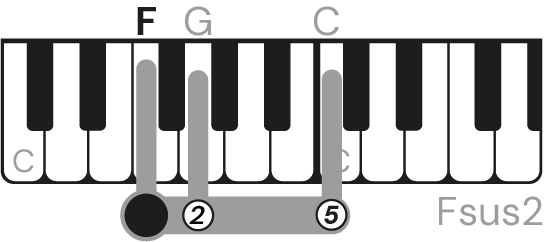
Suspended 2nd
A suspended chord removes/suspends the third and replaces it with either the 2nd or the 4th.
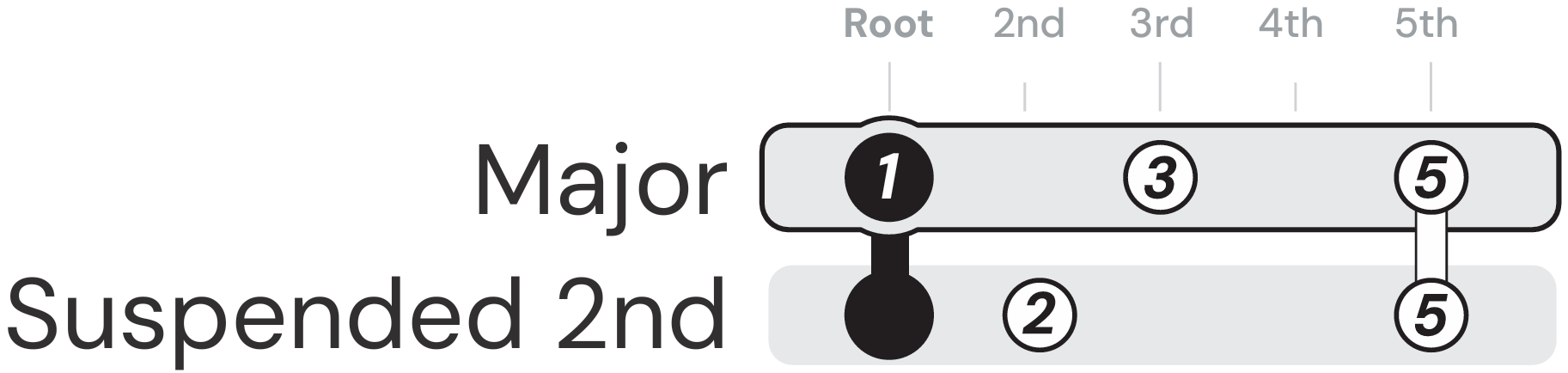
Name: F suspended 2nd
Symbol: sus2
Trivia: Suspended chords have an unresolved, open and ambiguous sound because they lack the major or minor third. ‘Every Breath You Take’ by The Police heavily features sus2 chords throughout the song, contributing to its ethereal and slightly mysterious vibe.
Suspended 4th
The sus4 chord replaces the third with the 4th scale degree.
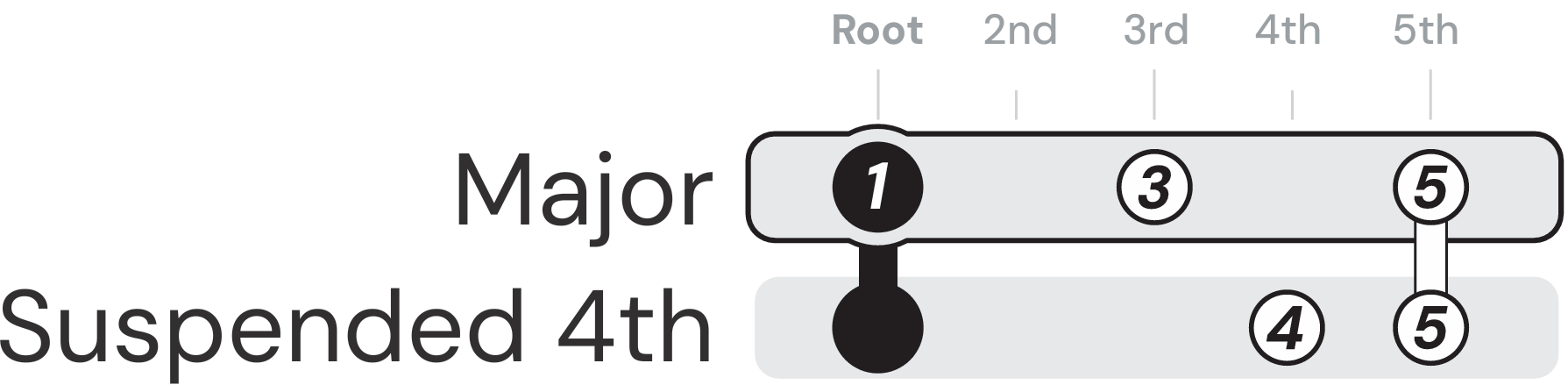
Name: F suspended 4th
Symbol: sus4, Fsus (as the suspended 4th is more common than the 2nd, when you see just ‘sus’ it typically refers to sus4)
Trivia: Sus2 chord and sus4 chords are ambiguous and can be mistaken for each other. A Dsus2 has the notes D, E, A while an Asus4 has the notes A, D, E so they can be seen as inversions of each other. This effect can be used to modulate between keys.
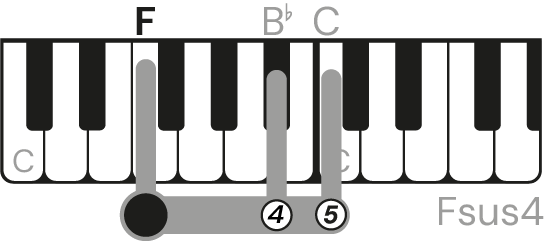
Did you know? You can add the 7th degree onto any suspended chord, in the same way as a triad, to make a Suspended 7th chord.
How To Play More
Understanding the chord formula adds to your vocabulary of chords and lets you be able to play interesting chord progressions and lets you express even more in creating music.
Want to learn more fancy jazz chords? (link to extended formula)
Want to find your root notes in a flash? (link to chord compass)
Want to put together chord progressions and write your first hit? (link to circle of fifths)