Every Chord Book Addendum
We are always striving to communicate ideas and concepts as clearly as possible and one of the best ways for us to discover where we can improve is feedback from the folks using the tool.
We have had a couple of comments regarding scales and open strings in the Every Chord Book and as we go to the next print I thought that I would share the changes and some of our process for improving our offerings.
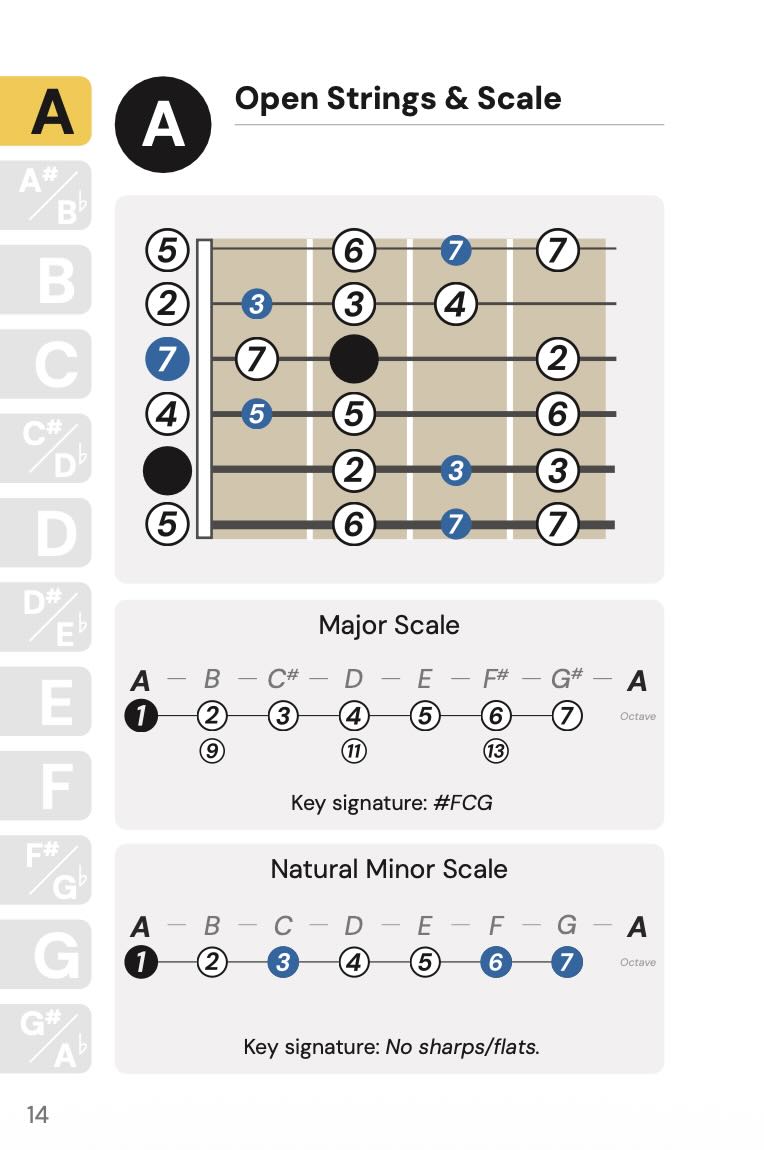
Above is the old version of the page which, if you have one of these books, is the page that you will be familiar with. For each chord section we start with the major scale and open notes. The intention of this page is to show the scale notes for A Major and probably most importantly the open string notes. From the comments it was clear that the additional blue notes (the flattened notes) that we added were confusing. The new page layout shown below addresses this:
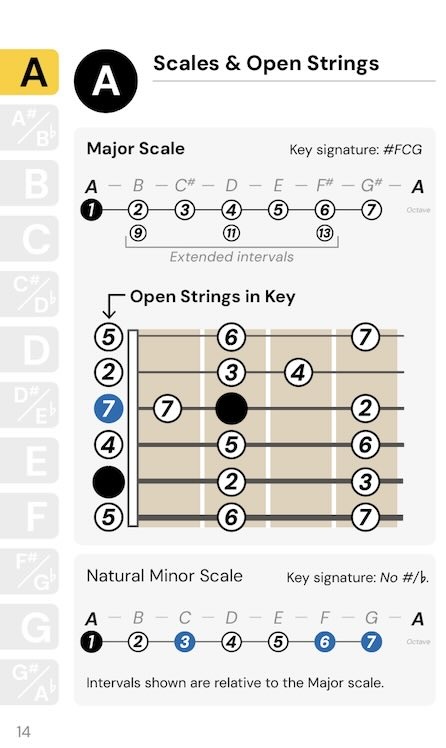
The primary goal for this page is to show you the notes in A major scale and what notes are available on the open strings.
The open string notes are really important especially when you move up the neck. The ability to use an open string for one of the chord notes is invaluable. In the A example above the G of the open G string is the flat 7 of the scale. Therefore if I am playing a dominant A7, or any extended chords, I can always play that 7, without fretting, by using the open G string.
The key signature shown on the right:

Instantly tells you what notes are in the key. The key of A Major has three sharps, F#, C# and G# all other notes are natural.
We decided to remove the flatted notes from the scale, except when they are on the open strings. The flatted blue notes shown were the notes that appear in all the following chords in the A section. The notes were a secondary consideration and can be easily deduced from the major scale notes. To be consistent we should have also added the augmented 5th (red note) but we felt that this was making the scale overly busy. The feedback received was that they were already confusing so we have removed them.
Finally the Natural Minor Scale is additional information. We did not show this on the fretboard diagram. This added to the confusion. The notes in the minor scale are shown relative to the Major scale and flag how the Natural Minor Scale differs from the Major Scale. The new diagram calls this out and separates the Natural Minor Scale from the Major Scale and its fretboard visualisation to hopefully reduce the confusion.
This was way too long a post to say your feedback is invaluable and really appreciated.