Beginner's Guide to Circle of Fifths
The Circle of Fifths is a powerful tool that helps musicians understand music theory concepts such as key signature and scale/chord relationships. It also opens up new creative possibilities that will ensure you’re never left short of creative direction in your compositions.
If you've been playing a musical instrument for a while, you've probably encountered the circle of fifths at some point.
It's a helpful tool for understanding music theory and gives easy access to important information when it comes to chords, scales, and their relationships.
Yet, despite the fact it can open up a world of possibilities and musical creativity, many musicians find it a dauntingly complex topic and don't take the time to fully understand how it works.
If this is you then look no further, you’re in the right place!
Today we’re going to teach you how to understand the circle of fifths and start applying its theory concepts to your playing.
How the Circle of Fifths Works
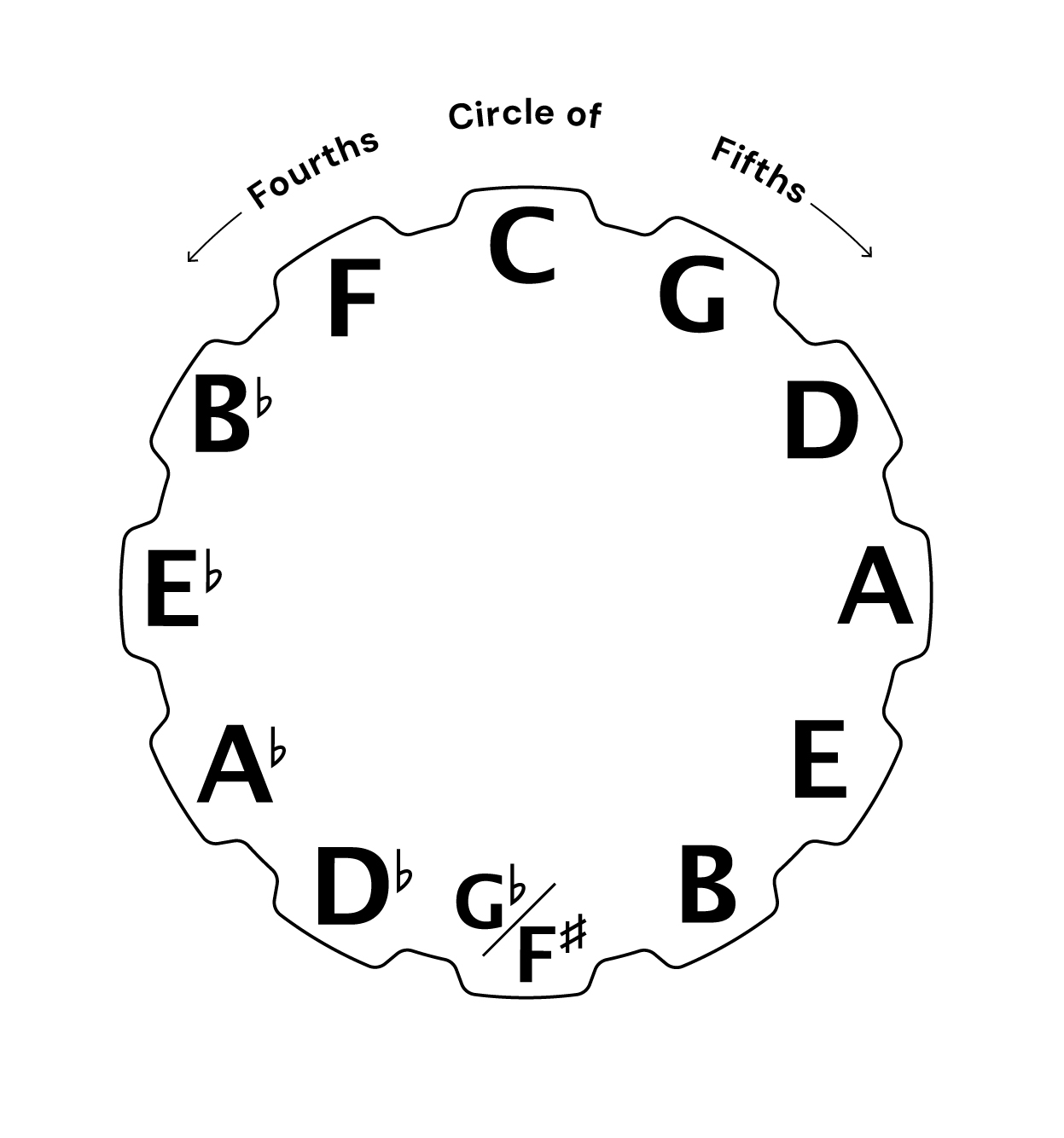
The circle of fifths is essentially a diagram that allows us to understand the relationship between different keys in music.
It shows you how many sharps or flats are in a given key and identifies its relative minor. It also provides creative insights, such as nearby related chords, to inspire unique chord progressions.
How to Read the Circle of Fifths
One of the most powerful things about the circle of fifths is that it's able to deliver lots of useful information in a relatively small area.
Let's take a look at how the circle of fifths is laid out and how it all works.
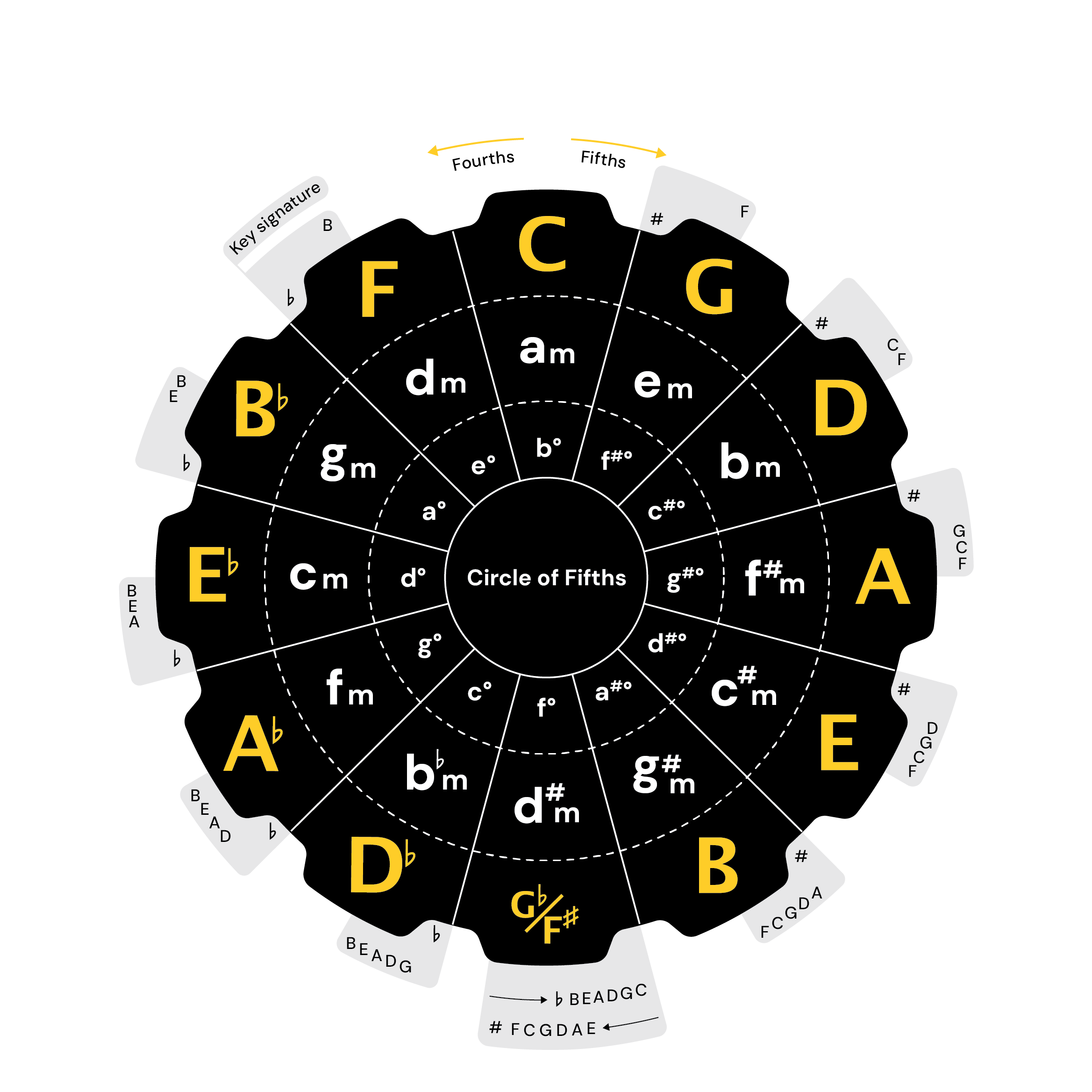
The Outer Circle
The big or capitalized letters in the outer circle represent all 12 of your major keys, starting with C major at the top which has zero sharps of flats.
As you follow the circle clockwise each step is a perfect fifth from the previous step, and adds 1 extra sharp (#) note.
Example:
Moving clockwise from C major you have G major which has 1 sharp, then D major which has 2 sharps, and so on. This is the 5th note from the root.
But if you go counterclockwise you move by a perfect fourth, and instead of sharps, you add flats. This is the 4th note from the root.
Example:
Moving counterclockwise 1 step from C to F contains 1 flat note, going 1 more step to Bb has 2 flats, and so on.
The Relative Minor
The inner circle works the same way as the outer one. Moving clockwise still adds sharps and climbs by perfect fifths. Moving counterclockwise moves by perfect fourths and adds flats.
The difference is they are all minor scales.
You’ve probably noticed that each minor scale sits directly underneath a major scale. This is what we call the relative minor. All this means is that they share the same notes as each other.
Example:
C major contains the same notes as A minor, and F major contains the exact notes as D minor.
Chord Relationships
Another useful thing you can do with the circle of fifths is find nearby chords that relate to your current chord.
This gives you ideas for where you might want to move to on your next chord change and is super helpful when improvising, or coming up with progressions for your own songs.
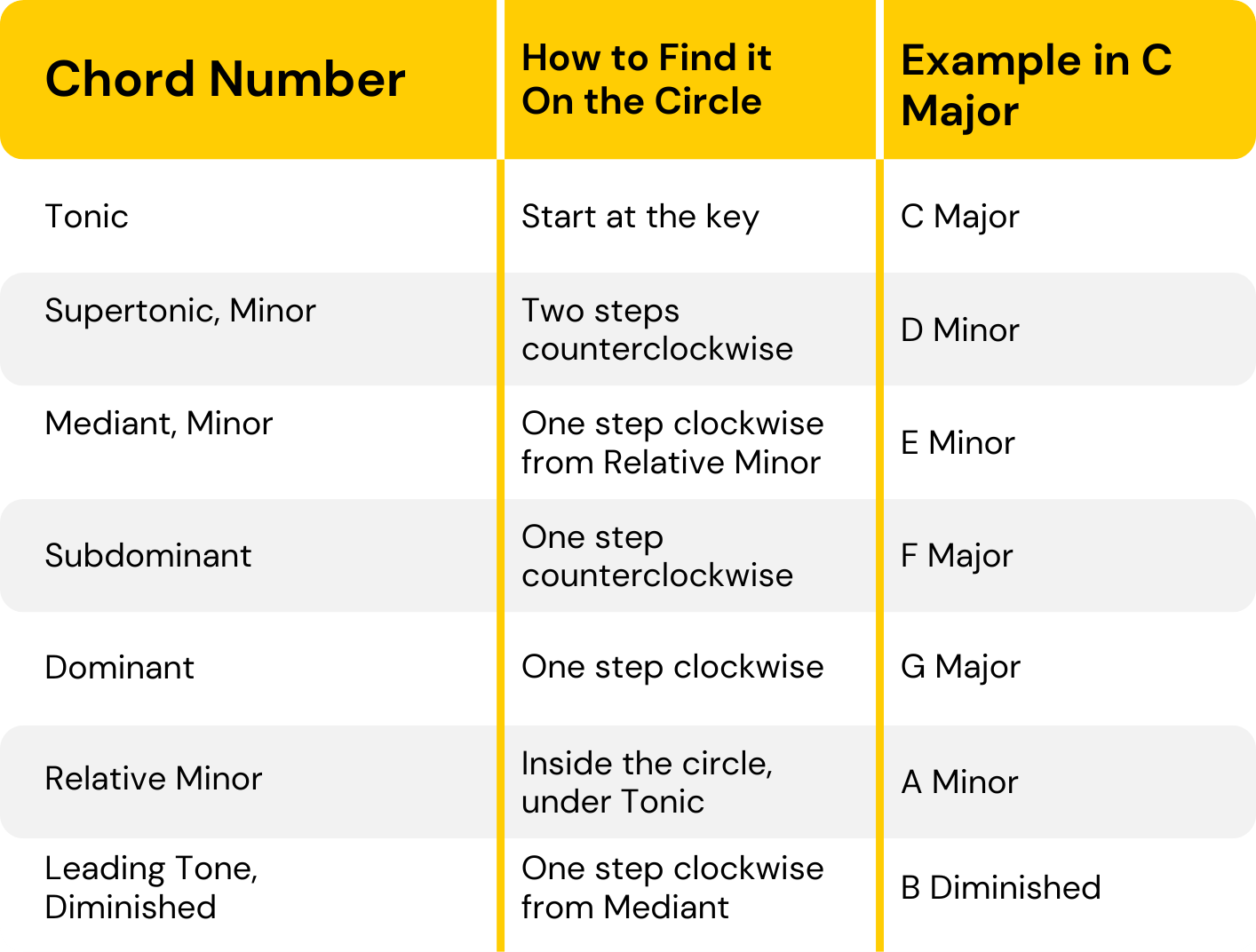
We can also easily find important interval and chordal movements based on the direction and how many steps we take. Here are a few examples of how this works:
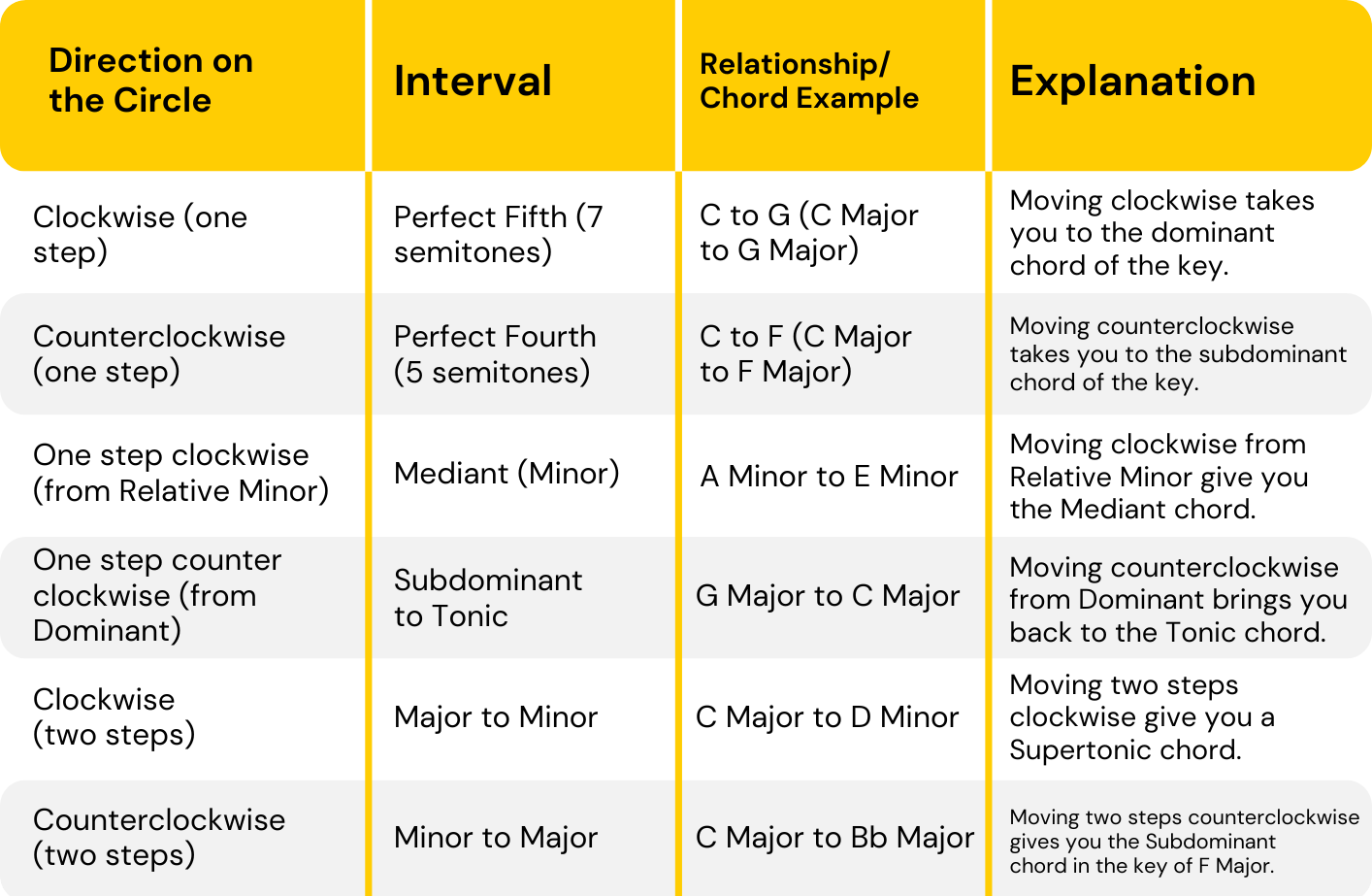
After spending some time with the circle of fifths, and with a little practice, you'll soon be traversing through keys and progressions with ease.
Feel free to download Noisy Clan’s Circle of Fifths Cheat Sheet as a convenient reference to help familiarize yourself with how the circle is laid out.
What You Can Do with the Circle of Fifths
It’s common for musicians to feel a bit intimidated by the circle of fifths. It does look pretty complex!
But taking a little time to familiarize yourself with how it works can unlock a wealth of benefits when it comes to music theory and songwriting.
As a music theory tool, the circle of fifths can help you:
Understand key signatures so you can quickly figure out how many sharps or flats are in a key.
Quickly identify relative major and minor keys, which is super helpful for songwriting and improvisation.
Identify chord progressions so you can play along with your favorite songs.
Ease your way into more advanced musical ideas like the circle of fourths and fifths, common movements used in classical and jazz music.
As a creative tool, the circle of fifths helps with:
Understanding chord progressions and harmonic movement, which is great for figuring out how to play your favorite songs or writing your own.
Utilize modulations and creative chord changes that you wouldn’t regularly discover by just staying within a single scale.
Make your chord progressions more colorful and interesting with borrowed chords.
Improve your improvisation prowess by visualizing chords and their relationships.
It's all well and good understanding how the circle of fifths is built, but how do you actually start using it to benefit you musically?
The good news is there are a ton of ways you can use the circle of fifths. Whether you're exploring music theory, songwriting, or transcribing music, you can start applying it right away.
Exposing Songs
The circle of fifths enables you to expose the keys and chords used in your favorite songs with ease.
This is an amazing theory practice technique where you can peek behind the curtain and start to understand how your favorite songs work.
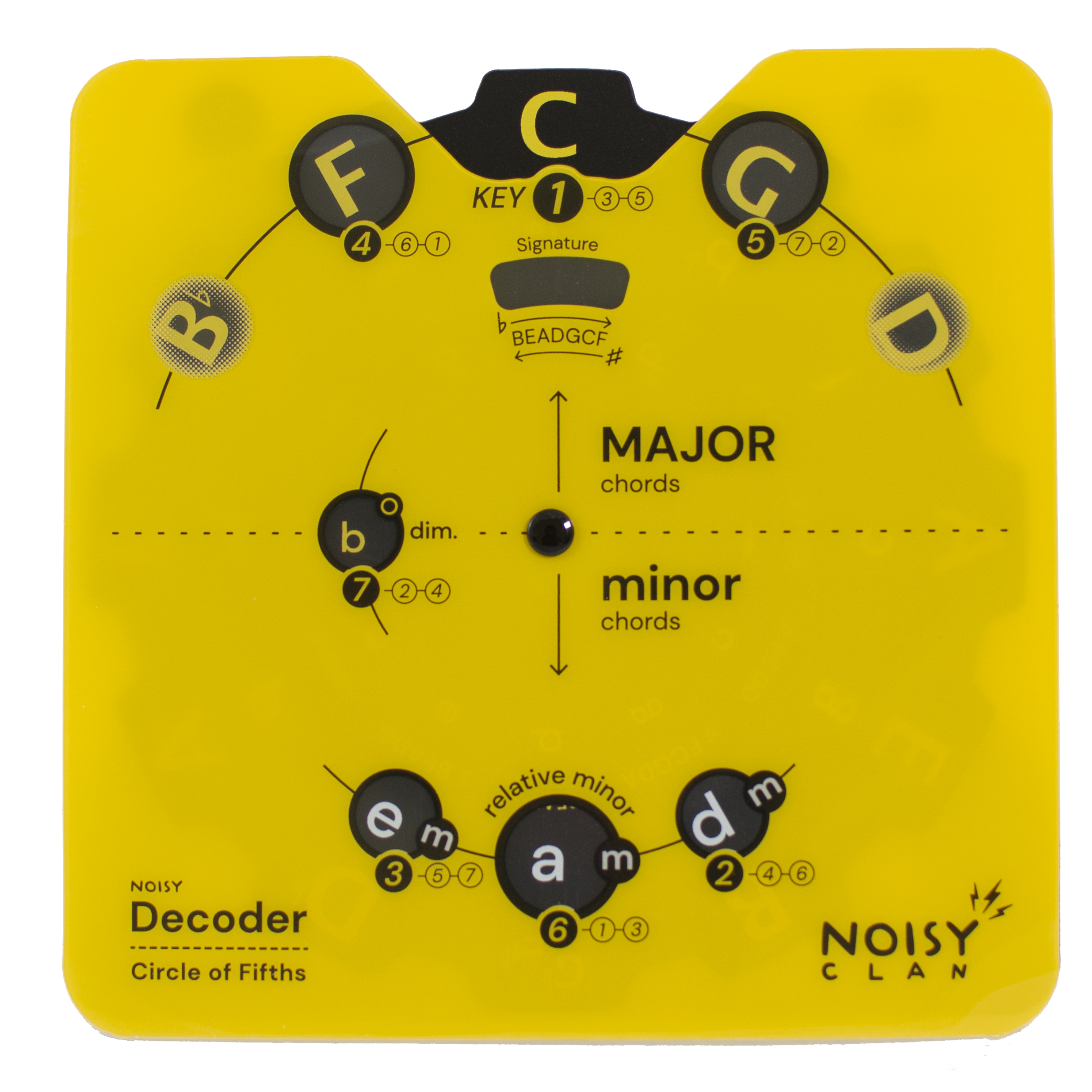
While this can be done with a regular circle of fifths, it's made even easier with the Noisy Clan’s Circle of Fifths Decoder because it intuitively masks out unnecessary information and shows only the relevant notes and chords for the song’s key.
Here’s how to do it:
First, you need to find a couple of chords you recognize from the song. Or alternatively, you can figure out just the root notes of each chord and go from there.
Let’s use “Let It Be” by The Beatles as an example.
Say you can identify the chords C major, G major, and A minor, but the other chords are a bit tricky and you’re struggling to figure them out by ear.Next, you rotate the decoder until the chords that you can hear are shown in the windows.
In this case, you would keep rotating the wheel until C major, G major, and A minor are all visible on the decoder.
This puts us in C major, and the decoder will now show us all 7 chords that are available within the C major scale.
Now the Decoder tells us all of the chords available within C major and you can start trying them out and see if any of them fit within the song.
In this example, the verse progression is:
C - G - Am - F
C - G - F - C
You’ll quickly be able to place that F chord that you struggled to find by ear. Now you know both the key of the song and all the chords!
Not only that, but the decoder also shows you the scale degree of each chord with a number by each window, so you'll also be able to see that this song uses the progression 1 - 5 - 6 - 4 (I - V - vi - IV).
Try this on as many songs as you can and you'll become a wizard at figuring out the key and chord progressions of all your favorite songs!
Want to try this right now? Head on over to the online Digital Decoder to put this into practice.
Getting Creative: Using the Noisy Clan Decoder
One of the downsides to the traditional circle of fifths is that there are a lot of notes and information that is not relevant to the scale/key you're playing.
It's easy to get lost with all that extra information.
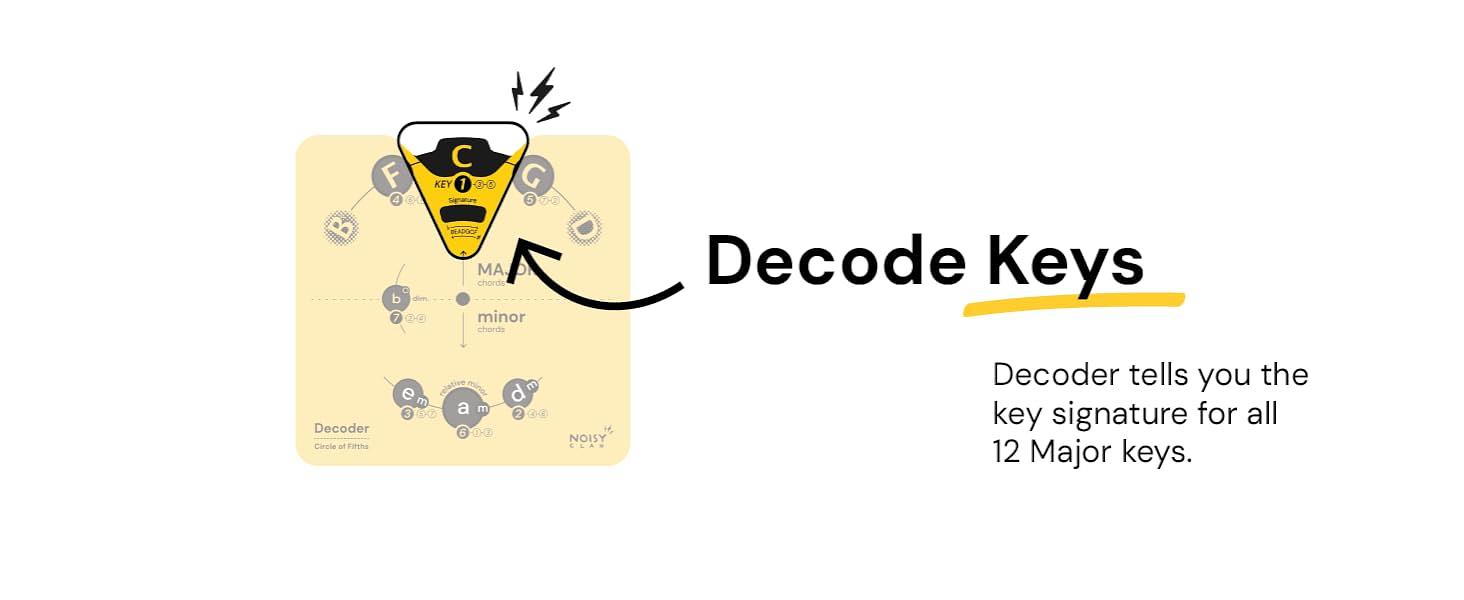
This is where the Noisy Clan’s Decoder: Circle of Fifths can help. We removed the distractions by focusing on the Key at hand. The example below shows you starting at the Key of C.
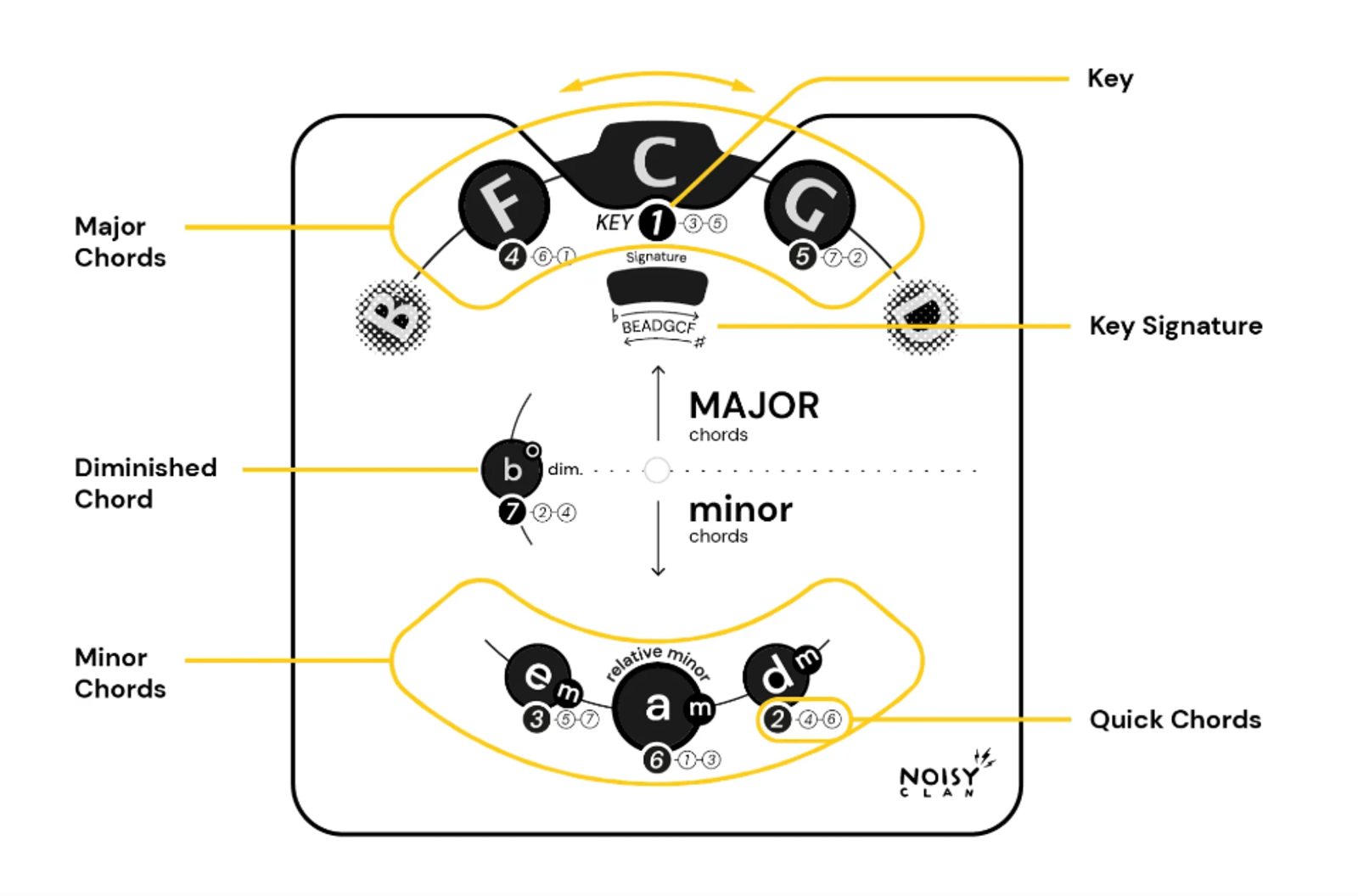
All you need to do is rotate the wheel at the top until your desired key is on display and you're shown only the important information relating to that key.
It shows you which chords exist within that scale, the order they are played in, the relative minor scale, and even some handy chord suggestions so you'll always have somewhere to go with your music.
Here's a quick example, let’s say you need to play in E:
All you do is rotate the wheel until E lines up with 'key' at the top, and you’re done! Try it here on our Digital Decoder online.
Now all the notes, chords, and relative minor information are all on display with no other clutter. It even tells you exactly which notes are sharped and flatted under 'Signature' so you don’t have to rely on memorizing a mnemonic.
This is extremely helpful in keeping you on track and in key when jamming with other musicians.
It's also a wonderful visual learning aid if you want to memorize your scales.
Using the circle of fifths for guitar? You’ll love the Guitar Circle of Fifths Poster as a convenient reference for guitar chords and scales.
Your Songwriting Assistant
The circle of fifths isn't just about gaining insight into pre-existing songs.
It's also a very powerful songwriting tool and can provide you with tons of ideas when it comes to creating chord progressions or melodies for yourself.
To start, choose a number sequence, this will correspond with the numbers on the window (also known as scale degrees).
Next, pick a key you want to play the progression in.
As a quick example, let's say we want to play in G major and use the chord progression
1- 4 - 5 - 1 (I - IV - V - I)
Now just turn the wheel until you're on G major, look at the numbers by the windows, and play the chords in that order.
So in this case you'll be left with the chords G - C - D - G.
Sounds good, right? It has a strong resolution and would work great for a chorus.
If you need inspiration for some great-sounding chord progressions, flip your decoder over and spin the wheel. 12 super-effective chord progressions are available on the back to help you get going.

Modulation and Transposition
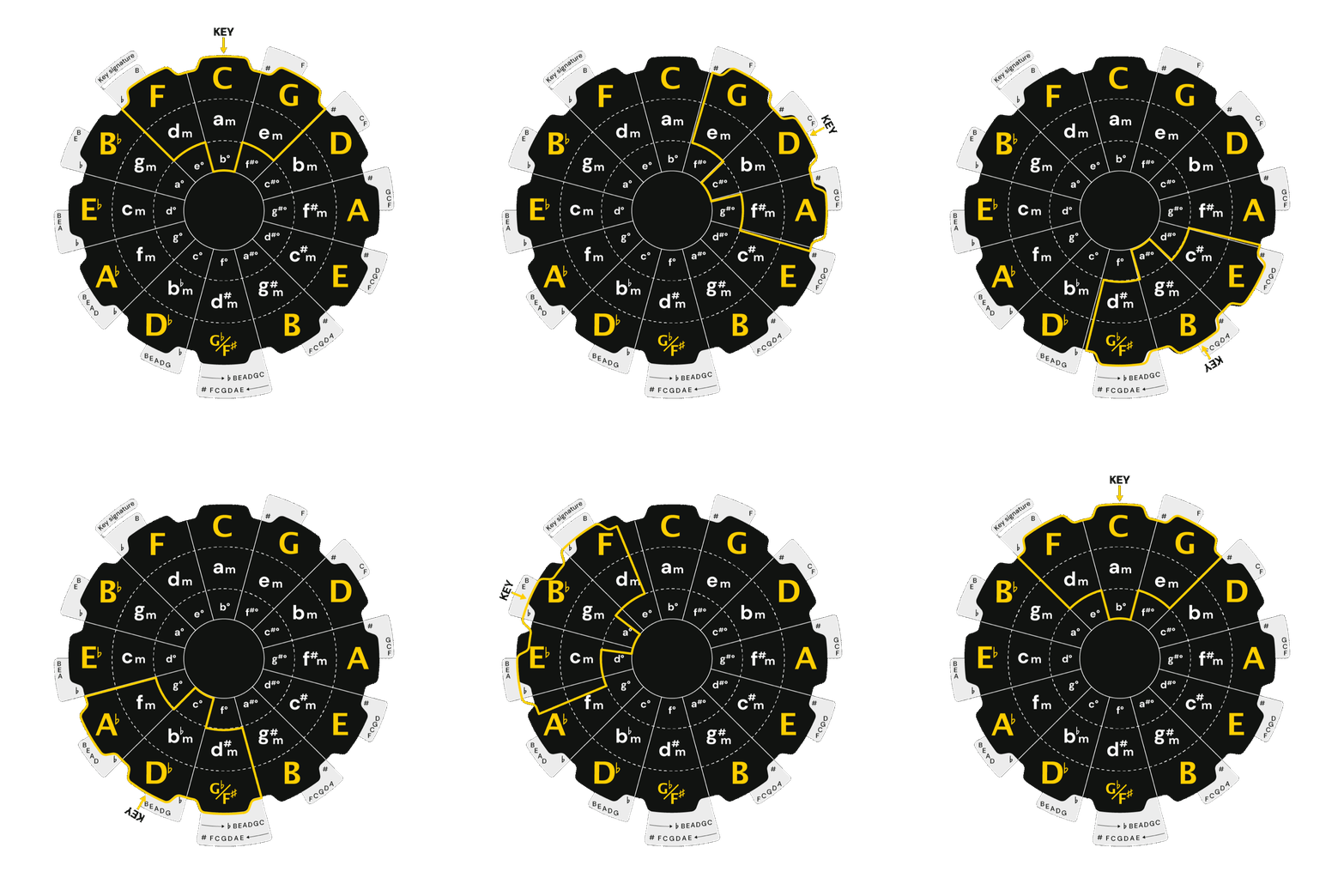
One of the most useful things about the circle of fifths is that it allows you to transpose music into a different key.
There's a myriad of reasons you might want to do this, maybe your singer's voice is tired, and they want to sing it in a lower key. Or perhaps your guitarist doesn't want to tune lower and it's more convenient to simply transpose the whole song.
Example:
You're playing a song in G major using the chords G - C - D - G, or 1- 4 - 5 - 1 (I - IV - V - I).
But you want to transpose the song down to C.
To get from G to C you move 1 step counterclockwise on the circle of fifths (which is a perfect fourth, or 5 semitones).
But what about the other 3 chords? Do the same thing! Move your C note one step counterclockwise to get F, move the D to get G, and move the G to get C.
Now you're left with the chords C - F - G - C, which is still a 1 - 4 - 5 - 1 progression, but it's now in C.
This process is made even easier if you have a Decoder: Transposition. As you turn the wheel 1 step counterclockwise, all the chords automatically move with it which saves you the trouble of moving each chord individually.
Learning Made Easy
These are just a few fun and creative ways to get you stuck into using the circle of fifths in real and practical musical scenarios.
As you can see, the circle of fifths isn't as difficult or confusing as it once was at your initial first glance.
Musicians of any age or skill level can get good value out of applying some of the exercises covered in this article to their own musical endeavors. Happy playing!