Beginner Guitar Exercises: Nashville Numbering System
The Nashville Numbering System uses numbers as a handy way for musicians to understand and communicate chords and progressions without worrying about thousands of chords.
Example in the key of G Major:
• The G Major scale consists of only 7 notes: G - A - B - C - D - E - F#
• A number is sequentially assigned to each of these notes, starting with the root (G) as 1:

Each of these notes forms the basis of a chord. The chord takes the same number as the note.
Let’s look at our chord progression G, D, Em, C:

• G Major is the first chord in the key of G, so it’s represented by 1.
• D Major is the fifth chord in the key of G, so it’s represented by 5.
• E minor is the sixth chord in the key of G, so it’s represented by 6m.
• C Major is the fourth chord in the key of G, so it’s represented by 4.
So, the chord progression G → D → Em → C in the key of G Major can be called a 1 → 5 → 6 → 4 progression, in the Nashville Number System.
Sometimes you will see minor chords represented by an 'm', sometimes with a dash and sometimes with no representation at all, and it will depend on whether you are playing in Major or minor keys.
Understanding the Numbers
The Nashville Numbering System vs Chord Tone Intervals
The Nashville Number System assigns a number to each chord in a key, based on the scaledegree that the chord is built on. The 1-3-5 manifesto explains how to build chords. The scaleis at the heart of both these systems and scale degrees are the seven numbered notes used in both systems. This can be confusing.
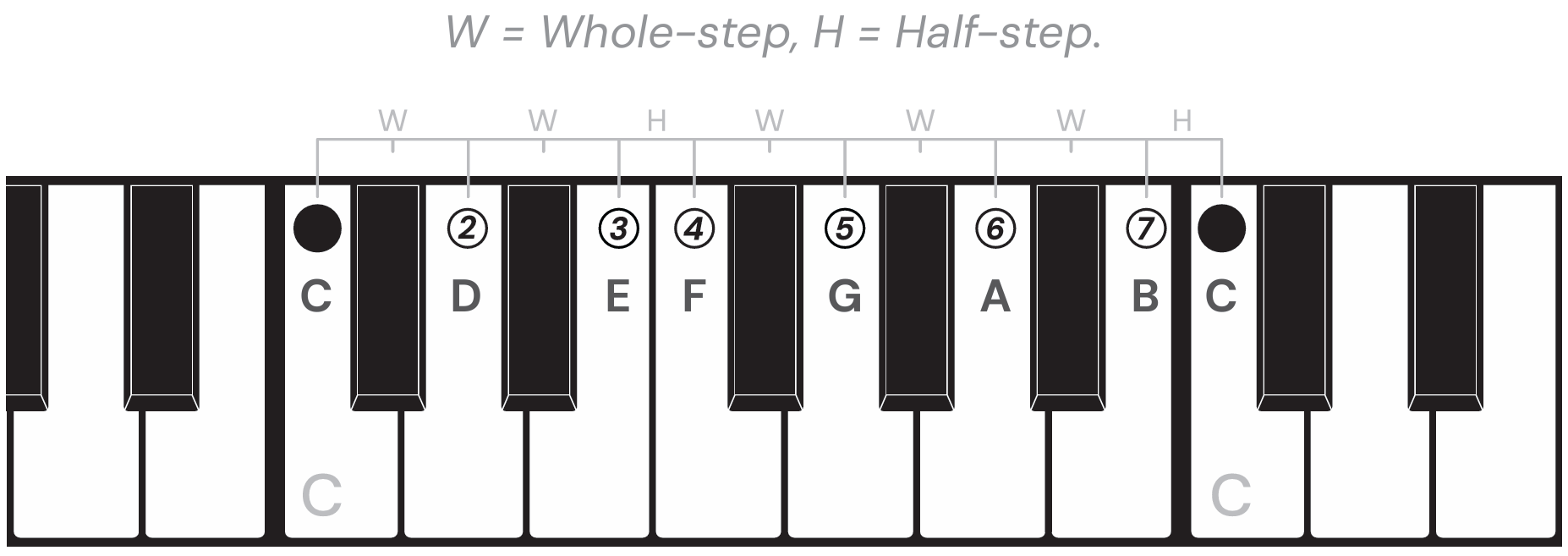
The Nashville Number System: Chords in a Key
To clarify, Nashville Numbering is a shorthand for writing chord progressions. Instead of notes (G Major, C Major, D Major), chords are written as scale degrees numbers (1, 4, 5) relative to a key.
The 1-3-5 manifesto reminds us how simple it is to build a chord using the root, third and fifth from a scale. G Major consists of the notes G (root), B (3rd), and D (5tf). Both use scale degrees, Nashville Numbering is for progressions and 1-3-5 is the shorthand we use for chord building in our chord formula.
What stage are you at with playing chords in a progression?
Pause & place: I know the shapes, but I have to stop the rhythm for a second to set my fingers.
Muscle memory: I know the chord shapes, but I have no idea what notes or numbers I'm playing.
Connecting the dots: I can change chords cleanly, but I don't really know why they work together.
Second nature: I know the shapes, intervals and the progression numbers without having to think twice.
If you didn't pick the last option, don't sweat it. Most of us have spent way too long stuck in the exact same spot.
We set up the NoisyClan community specifically to help players break past those brick walls and actually make sense of the neck. Drop by to ask questions, trade tips, and work through it with a group of guitarists on the same page.
Play more.
Shop learning materials | Music learning videos | Keep up with our socials