Beginner Guitar Exercises: Circle of Fifths
One of the best musical cheats is the Circle of Fifths. This is a visual map that arranges all 12 keys in a circle starting from C at the top. Moving clockwise, it places the most closely related keys next to each other.
It doesn’t simply list the keys alphabetically (A, A#, B) around the circle. Each adjacent key is a 5th interval from the next, C → G → D → A etc. all the way back to C again.
To construct your own Circle of Fifths, begin with C and count up five letters of the alphabet. This will lead you to G Major, the key most closely related to C Major in terms of shared notes. From G, count up another five letters (looping back to A after G) to arrive at D, which is the key most similar to G. Repeat this 12 times and you will have recreated the Circle of Fifths.
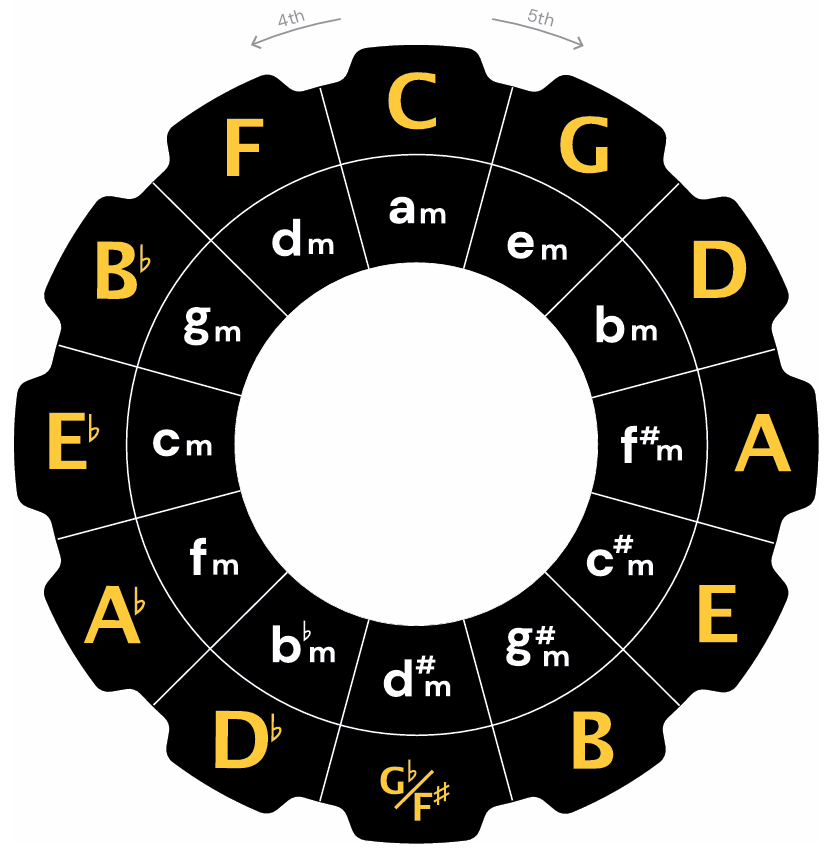
The Circle of Fifths repeatedly shows up across your fretboard in standard guitar tuning and is invaluable for learning notes on the fretboard.
The secret to the circle of fifths is that the Keys are not arranged sequentially. It is not like a clock, it does not start at A, followed by A#, B etc. The circle of fifths starts with C at the top. As we discussed the key of C has only natural notes with no sharps or flats. The next clockwise key added to the circle is the key most closely related to C. That key is G, which is a fifth away from C.

Here are the unique notes contained in the G Major Scale.
G, A, B, C D, E, F#
The difference between the key of C and the key of G is only one note. The G Major scale has all natural notes like C Major except the F#. This means they have similar key signatures and share common chords. Within songs, keys act like an anchor; they tell you which group of chords and notes will sound good in that key.
The key that is closest to G (but not C Major) is D Major, which is a 5th away from the key of G Major. This repeats around the circle in a clockwise direction until we arrive back at C Major and gives us the Circle of Fifths.
Direction is important. Moving up from C to G is a 5th. Moving up from G to C is only a fourth.
Understanding the Circle
The Circle of Fifths positions the key of C Major at the top. The inner ring shows the relative minor scale for each major key. We simplify the circle by not showing diminished chords.
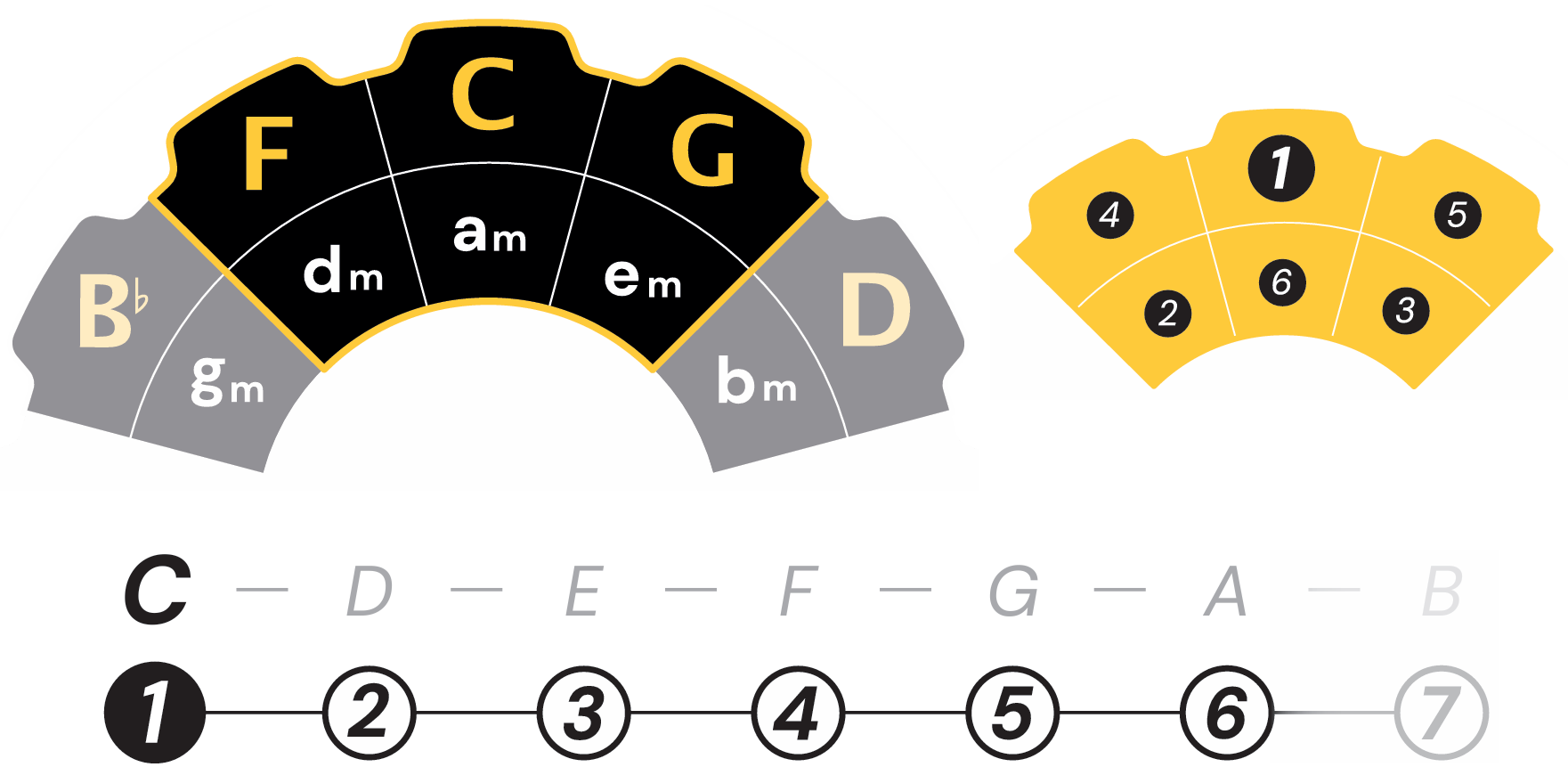
The six highlighted chords are all in the key of C major. The yellow key on the right shows the 'Nashville Number' for each chord (click here to learn more about the Nashville Numbering System)
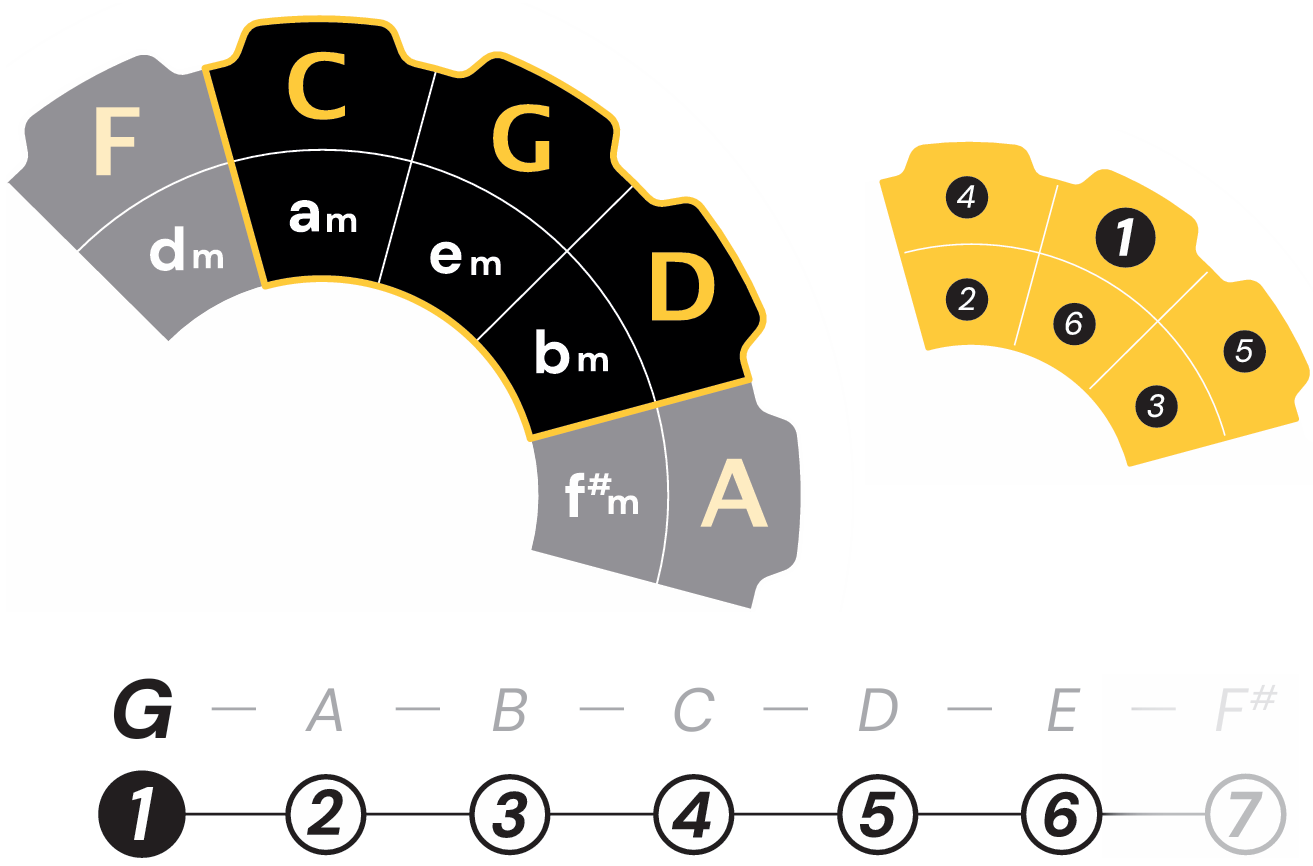
We have been playing in the key of G major. The six common chords in G are highlighted below and numbered in the yellow key. Our chord progression 1 → 5 → 6 → 4 can easily be read, G → D → Em → C. Four chords are shared between the two keys and two have changed: D and Bm, as seen below.
What stage are you at with playing chords in a progression?
Pause & place: I know the shapes, but I have to stop the rhythm for a second to set my fingers.
Muscle memory: I know the chord shapes, but I have no idea what notes or numbers I'm playing.
Connecting the dots: I can change chords cleanly, but I don't really know why they work together.
Second nature: I know the shapes, intervals and the progression numbers without having to think twice.
If you didn't pick the last option, don't sweat it. Most of us have spent way too long stuck in the exact same spot.
We set up the NoisyClan community specifically to help players break past those brick walls and actually make sense of the neck. Drop by to ask questions, trade tips, and work through it with a group of guitarists on the same page.
Play more.
Shop learning materials | Music learning videos | Keep up with our socials